
WELCOME BONUS 200%
UP TO €1500 + 200
FREE SPINS
UP TO €1500 + 200
FREE SPINS
Home → Blackjack
Blackjack at Stellar Spins: Variants, Rules and Payouts
Latency under 2 seconds at the live table
Infinite Blackjack, a live table game provided by Evolution, offers an unlimited number of player seats with bets ranging from 1 EUR to 5,000 EUR. The game features four side bets: Any Pair, 21+3, Hot 3, and Bust It. This setup aims to provide a smooth and responsive gaming environment for all participants.
Quantum Blackjack Plus Live, by Playtech, also accommodates bets from 1 EUR to 5,000 EUR and boasts an RTP of 99.57% with optimal strategy. It introduces Quantum multipliers up to 1,000x on three-card 21 point combinations. This variant enhances potential payouts through its multiplier system.
Lightning Blackjack, another Evolution offering, has a bet range of 1 EUR to 2,500 EUR and an RTP of 99.56%. This version incorporates Lightning multipliers up to 25x on winning hands. These live dealer games are designed to maintain low latency for an engaging player experience.
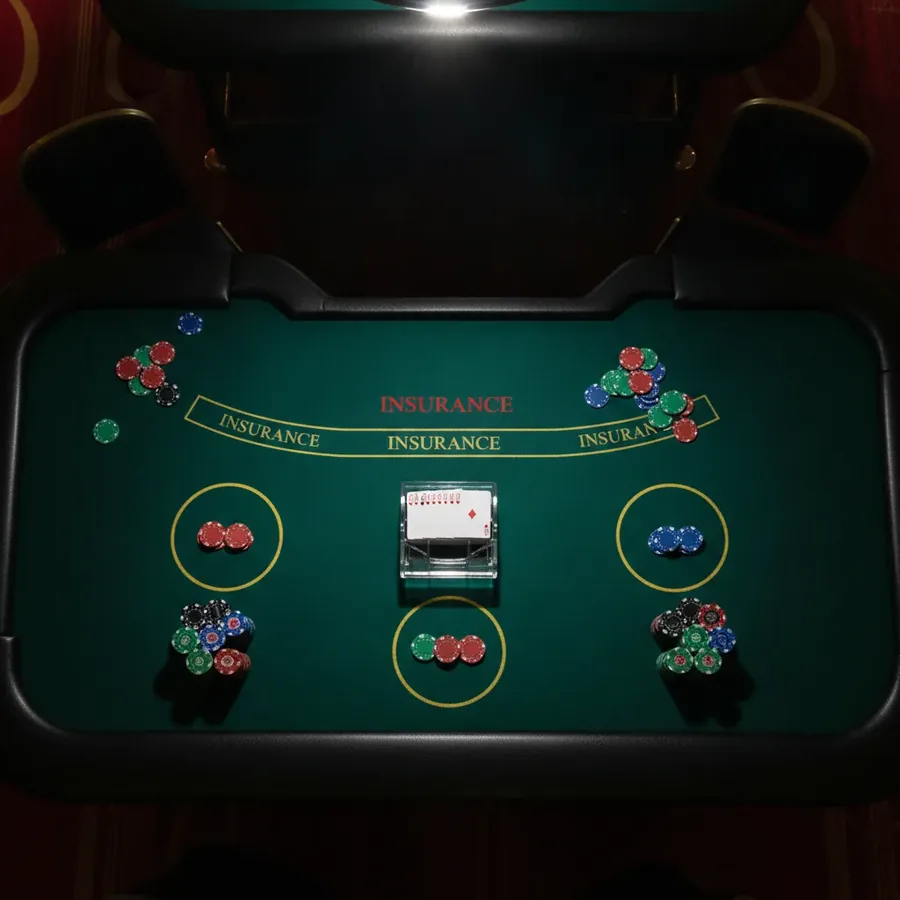
Side Bets Increase House Edge to 5 Percent
Blackjack Insurance, with 6 to 8 decks, presents a side bet with an RTP of 92.53%, resulting in a house edge of 7.47%. This side bet is typically up to 50% of the main bet when the dealer shows an Ace. Basic strategy dictates always declining this bet unless card counting indicates a True Count of +3 or higher.
The Blackjack Liberal Vegas Strip variant, featuring liberal rules and a 3:2 payout, has an RTP of 99.72% and a house edge of 0.28%. This variant includes favourable rules such as S17, DAS, and Late Surrender. The low house edge is attributed to these player-friendly regulations.
Conversely, when a Blackjack payout is set at 6:5 instead of 3:2 for a 6-deck game, the RTP drops to 98.15%, increasing the house edge to 1.85%. This change significantly benefits the casino, as a 10 EUR bet on Blackjack would yield 12 EUR instead of 15 EUR.
What Push Means: Stake Returns to You
In Blackjack, a 'push' occurs when the player's hand total matches the dealer's hand total. In such instances, the player's original stake is returned, meaning neither the player nor the dealer wins. This outcome does not affect the player's balance, as their bet is simply returned.
Blackjack Liberal Vegas Strip, with its 3:2 payout for a blackjack, offers an RTP of 99.72% and a house edge of 0.28%. This variant includes favourable rules such as S17, DAS, and Resplit, contributing to a lower house advantage. A push on any other hand results in the stake being returned.
The Blackjack 6 Decks game, with an RTP of 99.54% and a house edge of 0.46%, also operates on the principle that a push results in the stake being returned. This is a standard rule across most Blackjack variations, ensuring that ties do not result in a loss for the player.
Six Decks to Eight Decks in the Shoe
The Blackjack 6 Decks variant, adhering to S17, DAS, and DOA rules with a 3:2 payout, offers an RTP of 99.54% and a house advantage of 0.46%. This game configuration is standard for many table games, providing a balanced gameplay experience. The dealer stands on a soft 17 in this variant.
When comparing shoe compositions, a switch from 8 decks to 6 decks in Blackjack typically reduces the house edge by approximately 0.02 percentage points. While seemingly minor, this adjustment can have a cumulative effect over extensive play sessions. This reduction is often observed in variations with fewer decks.
Blackjack Insurance, when played with 6 to 8 decks, carries a house edge of 7.47% and an RTP of 92.53%. This side bet is generally advised against unless card counting is employed. The number of decks used in the shoe can influence the effectiveness of certain betting strategies.
Soft Hand and Hard Hand Practically Distinguished
A Blackjack hand is considered 'soft' if it contains an Ace that can be counted as either 1 or 11 without busting. For example, an Ace and a 6 (Ace-6) is a soft 17. The Blackjack Liberal Vegas Strip variant, with an RTP of 99.72%, allows the dealer to stand on a soft 17 (S17).
Conversely, a 'hard' hand is one where all Aces must be counted as 1 to avoid busting, or a hand that does not contain an Ace. For instance, a 10 and a 7 is a hard 17. The Blackjack 6 Decks variant, with an RTP of 99.54%, also specifies that the dealer stands on a soft 17.
The distinction between soft and hard hands is crucial for applying basic strategy in Blackjack. For example, with a soft hand, a player may hit more aggressively as the Ace can convert to a 1 if a high card is drawn. The Blackjack Ein Deck variant, offering an RTP of 99.85%, follows classical rules where such distinctions are paramount.
Blackjack variants at a glance
| Variant | Payout | House edge | Rule | Bet range |
|---|---|---|---|---|
| Blackjack Liberal Vegas Strip (liberale Regeln, 3:2) | 99.72% | 0.28% | Günstigste Regelkombination: S17 + DAS + Resplit + Late Surrender. Standardabweichung 1,15 | Blackjack 3:2, Gewinn 1:1 |
| Blackjack Surrender (Late Surrender) – Regel-Effekt | n.a. (Regel-Modifikator) | −0.08 Prozentpunkte | Spieler gibt Hand nach Dealer-Blackjack-Prüfung auf, verliert die Hälfte des Einsatzes. Verbessert RTP um ca. 0.08 Prozentpunkte. Early Surrender ist wesentlich wertvoller (bis −0.6 Prozentpunkte), aber extrem selten. | Rückzahlung 50% des Einsatzes |
| Blackjack 6 Decks, S17, DAS, DOA, Auszahlung 3:2, Basisstrategie | 99.54% | 0.46% | Dealer steht auf Soft 17; Verdopplung auf jeder Zweierkarte; Verdopplung nach Split erlaubt; keine Aufgabe. Basisstrategie ist für diesen Wert zwingend | Blackjack 3:2, normaler Gewinn 1:1, Insurance 2:1 |
| Blackjack Insurance / Versicherung (6–8 Decks) | 92.53% | 7.47% | Separate Nebenwette bis 50% der Hauptwette, wenn der Dealer ein Ass hat. Basisstrategie schreibt IMMER Ablehnung vor (außer Karten zählen bei True Count ≥ +3). Bei einem Deck Vorteil ≈ 5.88% | Insurance 2:1 |
| Blackjack Auszahlung 6:5 statt 3:2 (6 Decks) | 98.15% | 1.85% | Ersatz von 3:2 durch 6:5 fügt exakt +1.39 Prozentpunkte zum Vorteil des Casinos hinzu – stärker als jede andere Regeländerung. Bei $10 Einsatz zahlt Blackjack $12 statt $15. | Blackjack 6:5, Gewinn 1:1 |
| Blackjack Ein Deck, klassische Regeln, 3:2 | 99.85% | 0.15% | Weniger Decks = niedrigerer Vorteil; ein Deck gibt ca. −0.48 Prozentpunkte gegenüber 8 Decks. Oft durch 6:5 Auszahlung kompensiert. | Blackjack 3:2, Gewinn 1:1 |
Insurance Pays 2:1 Yet Still Costs Money
The Blackjack Insurance side bet, often offered when the dealer shows an Ace, pays 2:1. Despite this payout, the RTP for this bet is only 92.53%. This figure indicates a house edge of 7.47%, making it a less favourable option for the player in the long run.
For example, with a 100 EUR bet on Blackjack, taking the insurance bet of up to 50 EUR would yield 100 EUR if successful. However, the 7.47% house edge means that, on average, for every 100 EUR wagered on insurance, 7.47 EUR is retained by the casino.
Basis strategy for Blackjack universally advises against taking insurance, unless employing advanced card counting techniques where the true count is +3 or higher. This recommendation stems from the lower RTP compared to the main game, which can be as high as 99.85% for a single-deck game.
Step-by-step Split at the Live Table
Blackjack Split/Double/H17 variants allow players to split their initial two cards into up to four separate hands. This feature can be strategically beneficial, particularly when dealt pairs of Aces or eights. The rule modification for splitting Aces, for instance, improves RTP by approximately 0.08 percentage points.
When a player chooses to split, the original bet is doubled as a new hand is initiated with the second card. For example, if a player bets 10 EUR and decides to split a pair of eights, an additional 10 EUR is wagered, resulting in a total stake of 20 EUR for that turn.
The option to double down after splitting, known as DAS, further enhances gameplay. This rule permits doubling the bet on a card for any new hand formed after a split, contributing an estimated 0.14 percentage points improvement to the RTP. This offers more flexibility and potential for larger wins.
Clicked Too Late: Hand Is Automatically Held
In certain live Blackjack variants, such as Lightning Blackjack by Evolution, players have a limited time to act on their hand. If a player does not make a decision to hit, stand, split, or double before the timer expires, the hand is automatically held. This ensures the game progresses at a consistent pace.
This automatic holding feature is particularly relevant in fast-paced games where time constraints are in place, like Lightning Blackjack which offers multipliers up to 25x. The time window for action is designed to keep the game dynamic, with players needing to be ready to make their choices quickly.
For Infinite Blackjack by Evolution, which offers unlimited seats, players must also make their decisions within the allotted time. Failure to do so results in the hand playing out with the default action, typically standing on the current hand value. This is a crucial aspect of managing your gameplay and budget in time-sensitive scenarios.
Splitting costs double bet: plan budget
The Blackjack Split option allows a player to divide their initial two cards into two separate hands, provided they are of the same rank. However, each new hand requires an additional bet equal to the original stake. Therefore, splitting a pair of eights, for instance, will double the immediate bet from 10 EUR to 20 EUR.
This doubling of the bet on splits directly impacts the player's budget management. If a player has a budget of 100 EUR and decides to split multiple times in a session, the total amount at risk can escalate rapidly. For example, two splits would mean 30 EUR is in play on those hands, plus the initial bet.
When playing Blackjack Liberal Vegas Strip, which features liberal rules and a 3:2 payout for Blackjack, splitting still incurs the doubled bet. The RTP for this variant is 99.72%, but understanding the cost of splitting is vital for maintaining control over expenditure during extended play.
What doesn't count towards turnover at 10 percent?
Table games, including various Blackjack variants and Live Casino offerings, contribute only 10% towards the wagering requirements of bonuses. This means that for every 100 EUR wagered on these games, only 10 EUR counts towards clearing the bonus. This applies to games like Blackjack Split/Double/H17 and Live dealer games such as Infinite Blackjack.
The welcome bonus offers a 300% match up to 2,000 EUR plus 100 free spins. If a player claims the full 2,000 EUR bonus, a total turnover of 80,000 EUR would be required (2,000 EUR bonus x 40 wagering requirement). However, wagering on Blackjack only contributes 10% of that amount.
Therefore, a player wagering 100 EUR on Blackjack Liberal Vegas Strip, which has an RTP of 99.72%, would need to wager 10 times that amount, 1,000 EUR, on slots (which contribute 100%) to achieve the same turnover effect. This highlights the importance of understanding game contribution rates for bonus play.
Bet two percent of bankroll per hand
A recommended strategy for managing funds involves betting two percent of a player's total bankroll on each hand of blackjack. This approach aims to prolong gameplay and mitigate the impact of short-term variance. For instance, with a bankroll of €1,000, a two percent bet would equate to €20 per hand.
This risk management technique is particularly relevant when considering games with varying house edges, such as Blackjack Auszahlung 6:5 which carries a house advantage of 1.85%. By limiting bets, players can absorb more losing hands without depleting their funds prematurely, ensuring a more sustained gaming session.
Adhering to this betting strategy means that a player with a €2,000 bankroll would bet €40 per hand. This limits potential losses during downswings and allows for a greater number of hands played, especially when engaging with variants like Infinite Blackjack which offers an RTP of 99.47%.
Soft 17: Dealer Hits or Stands
The rule regarding whether the dealer hits or stands on a soft 17 (a hand totaling 17 with an ace counted as 11) can impact the house edge. When the dealer hits on soft 17, the house advantage increases by approximately 0.22 percentage points compared to when they stand.
For example, a Blackjack 6 Decks game with the dealer standing on soft 17 (S17) offers an RTP of 99.54%, resulting in a house edge of 0.46%. Conversely, if the dealer were to hit on soft 17 in a similar game, the RTP would decrease, and the house edge would rise.
Understanding this rule is crucial for players aiming for optimal strategy. In variations where the dealer hits soft 17, the house retains a slightly larger portion of bets over the long run. This difference is evident when comparing games like Blackjack Liberal Vegas Strip (RTP 99.72%) where the dealer stands on S17.
Insurance vs Even Money on Own Blackjack
Insurance is a side bet offered when the dealer's upcard is an ace, allowing players to bet on whether the dealer has blackjack. This bet pays 2:1, but it carries a significant house edge, reported at 7.47% for 6-8 deck games. Basic strategy dictates always declining this bet unless card counting indicates a true count of +3 or higher.
An alternative to insurance is 'even money' for players who have a blackjack. This option allows the player to receive an immediate payout equal to their bet amount, rather than risking a push or loss if the dealer also has a blackjack. This effectively locks in a win at a 1:1 ratio.
The decision between taking insurance or even money on a player's own blackjack has financial implications. While insurance presents a statistically unfavorable bet with a high house edge, accepting even money guarantees a payout, circumventing the risk associated with the dealer's potential blackjack, particularly in games with a 6:5 payout for blackjack.
One Deck vs Eight Decks in House Edge
The number of decks used in a blackjack game directly influences the house edge. A game played with a single deck can offer a significantly lower house advantage compared to games utilizing multiple decks, such as eight decks. Specifically, using one deck reduces the house edge by approximately 0.48 percentage points relative to eight decks.
For instance, a Blackjack Ein Deck game with classic rules and a 3:2 payout boasts an impressive RTP of 99.85%, translating to a house edge of just 0.15%. This is considerably lower than games that employ more decks, often by necessity to allow for variations like Blackjack Auszahlung 6:5.
Many casinos compensate for the reduced house edge in single-deck games by implementing less favorable rules, such as the 6:5 payout for blackjack instead of the standard 3:2. This change alone increases the casino's advantage by 1.39 percentage points, making the game less appealing despite the single-deck advantage.
Highroller from 500 EUR per hand
For players who prefer higher stakes, certain tables accommodate bets starting from €500 per hand. This caters to a segment of players seeking more significant action and potentially larger wins. For example, Infinite Blackjack and Quantum Blackjack Plus Live both have a maximum bet limit of €5,000 per hand.
These high-stakes tables are often found within live casino environments, such as those offering Evolution or Playtech games. Quantum Blackjack Plus Live, with its Quantum multipliers up to 1,000x on three-card 21s, provides an exciting prospect for high rollers. Lightning Blackjack also offers multipliers up to 25x.
The availability of such high bet limits means that players engaging with a €2,000 welcome bonus, which requires 40x wagering, could potentially meet their obligations more quickly. However, it also amplifies the risk of substantial losses if not managed prudently, with a single hand potentially costing €500 or more.
Contact
Live - online chat
Banking









Providers












Stellar spins 2025